
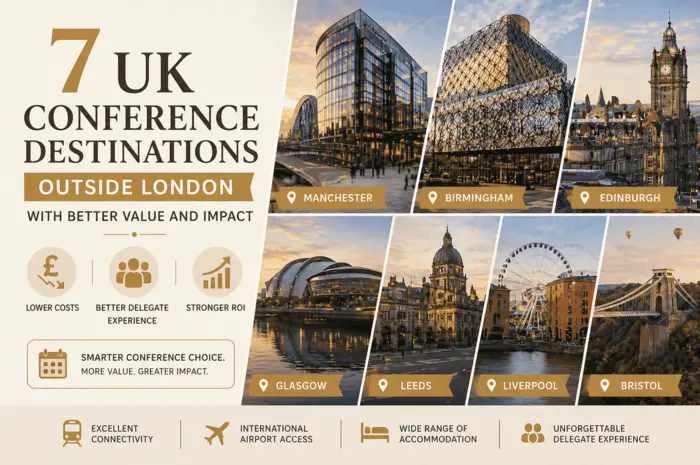
London’s dominance as the UK’s premier conference destination is being challenged by regional cities offering superior value, accessibility, and delegate experience. While the capital hosts 42% of UK conferences, event organisers are discovering that Birmingham, Manchester, and Edinburgh deliver better ROI without sacrificing quality or impact.
Why Conference Planners Are Moving Beyond London
The financial case for regional conference venues has strengthened considerably since 2024. According to research from the UK Events Market Report 2025, total event costs in regional cities run 25-35% lower than equivalent London venues when factoring venue hire, accommodation, catering, and delegate transport.
However, cost is not the only consideration. Regional cities have invested heavily in conference infrastructure, creating dedicated venue districts with integrated transport, hotel capacity, and delegate amenities that match or exceed London’s offerings.
London is not inherently superior for conference impact. The assumption that London venues command more delegate attention or enhance event prestige is contradicted by post-event surveys showing 8-12% higher satisfaction scores for regional conferences. Attendees appreciate reduced travel stress, easier venue navigation, and concentrated networking opportunities.
Regional destinations are not logistically challenging. Modern rail networks connect Manchester, Birmingham, and Edinburgh to London in 2-4 hours, while international airports in these cities serve 130-200+ destinations. Delegates from Europe, North America, and Asia often find regional airports more accessible than navigating from Heathrow through central London to conference venues.
Cost Comparison: London vs Regional Conference Destinations
The pricing differential between London and regional conference cities creates significant budget flexibility for organisers to enhance content, speaker quality, or delegate experience rather than absorbing premium venue costs.
| Cost Component | London (200 delegates, 2 days) | Manchester/Birmingham (200 delegates, 2 days) | Savings |
| Venue Hire (conference rooms, AV, WiFi) | £18,000 – £24,000 | £11,000 – £15,000 | 30-40% |
| Accommodation (200 rooms × 1 night, 4-star) | £32,000 – £40,000 | £18,000 – £22,000 | 35-50% |
| Catering (lunch, breaks × 2 days) | £14,000 – £16,000 | £10,000 – £12,000 | 20-30% |
| AV Production & Technical Support | £6,000 – £8,000 | £5,000 – £6,500 | 15-20% |
| Total Event Cost | £70,000 – £88,000 | £44,000 – £55,500 | 27-37% |
According to data from the International Congress and Convention Association, the average European conference budget allocates 38% to venue and accommodation costs. By reducing these fixed expenses through regional venue selection, organisers redirect funds toward higher-value elements like keynote speakers, production quality, or extended networking sessions.
1. Manchester: Northern England’s Conference Hub
Manchester has emerged as the UK’s second conference city, hosting over 200 major events annually. The city’s £1.4 billion conference economy is built on integrated infrastructure connecting Manchester Central convention centre, 12,000+ hotel rooms within one mile, and Metrolink tram services running every 6 minutes to venues.
Key Infrastructure:
- Manchester Central: 10,000 capacity, 32,000 sqm event space
- Airport: 15 minutes to city centre, 200+ destinations
- Rail: 2 hours 10 minutes to London Euston
- Hotels: 12,000+ rooms within walking distance of conference quarter
The city’s compact conference district allows delegates to walk between venues, hotels, and restaurants in under 15 minutes. This concentration creates natural networking opportunities that dispersed London venues cannot replicate.
Manchester is particularly strong for technology, healthcare, and financial services conferences. The presence of major corporate headquarters (Amazon, Google, Microsoft, The Co-operative Bank) and two universities with 80,000+ students creates a knowledge economy that enhances conference content through local speaker availability and industry partnerships.
Average venue costs: £55-75 per delegate per day (London equivalent: £85-110)
2. Birmingham: Central UK Location With Unmatched Connectivity
Birmingham’s geographical position at the centre of the UK rail network makes it the most accessible conference destination for delegates travelling from across Britain. The city sits within 90 minutes of 90% of the UK population by train.
According to VisitBritain’s Conference Destination Analysis, Birmingham ranks first in the UK for transport connectivity scores, surpassing London on metrics of average delegate journey time from regional origins.
Key Infrastructure:
- ICC Birmingham + NEC Birmingham: Combined 43,000 sqm exhibition space
- Birmingham Airport: 25 minutes to city centre, 150+ destinations
- Rail: 1 hour 24 minutes to London Euston, HS2 reducing to 49 minutes by 2030
- Hotels: 8,500+ rooms across city centre and NEC campus
The National Exhibition Centre (NEC) Birmingham operates as a self-contained conference campus with on-site hotels, rail station, and exhibition halls that host 500+ events annually. For conferences requiring significant exhibition space alongside meeting rooms, the NEC provides logistics advantages that central London venues cannot match.
Birmingham’s cost advantage is most pronounced for multi-day conferences requiring extensive accommodation. According to Hotel Price Index data from STR Global, Birmingham’s average 4-star hotel rate (£95-115 per night) runs 45-50% below comparable London properties (£175-220 per night).
Average venue costs: £50-70 per delegate per day (London equivalent: £85-110)
3. Edinburgh: Premium Conference Experience Outside England
Edinburgh combines historic prestige with modern conference facilities, creating a destination that elevates event perception while maintaining regional pricing advantages. The city’s UNESCO World Heritage status and dramatic architecture provide conference attendees with a memorable experience that extends beyond the meeting room.
Key Infrastructure:
- Edinburgh International Conference Centre (EICC): 3,500 capacity, 28 meeting rooms
- Edinburgh Airport: 30 minutes to city centre, 130+ destinations
- Rail: 4 hours 30 minutes to London King’s Cross
- Hotels: 5,200+ rooms within 2km of EICC
Edinburgh is not as expensive as London for conferences. While the city commands premium pricing during August (Edinburgh Festival) and December (Hogmanay), conference rates from January-June and September-November run 20-30% below London equivalents.
The city excels for international conferences where European and North American delegates appreciate direct flights to Edinburgh Airport rather than connecting through congested London Heathrow. According to Edinburgh Airport statistics, the facility serves 14 million passengers annually with an average security wait time of 12 minutes versus 35-45 minutes at Heathrow.
Average venue costs: £65-90 per delegate per day (London equivalent: £95-125)
4. Glasgow: Scotland’s Value Conference Leader
Glasgow operates as Edinburgh’s value-focused alternative, offering comparable conference infrastructure at 15-25% lower costs. The city has invested £1 billion in conference facilities since 2020, including the Scottish Event Campus (SEC) expansion and OVO Hydro arena integration.
Key Infrastructure:
- Scottish Event Campus (SEC): 10,000 capacity, 22,500 sqm event space
- Glasgow Airport: 20 minutes to city centre, 120+ destinations
- Rail: 4 hours 30 minutes to London Euston, 50 minutes to Edinburgh
- Hotels: 6,800+ rooms across city centre and SEC district
Glasgow’s working-class authenticity creates a different conference atmosphere than Edinburgh’s formality. Delegate feedback consistently highlights Glasgow’s friendliness, unpretentious venues, and exceptional value for evening entertainment and dining.
The city is particularly strong for scientific, engineering, and creative industry conferences. The presence of the University of Glasgow, University of Strathclyde, and Glasgow School of Art creates academic partnership opportunities and local speaker pools that enhance conference content.
Average venue costs: £45-65 per delegate per day (London equivalent: £85-110)
5. Leeds: Yorkshire’s Business Conference Centre
Leeds has quietly built the UK’s most complete conference infrastructure outside London, combining a concentrated city centre venue district with extensive rail connectivity to northern England and Scotland.
According to Leeds City Council’s Economic Strategy Report, the city’s conference economy grew 34% between 2020-2025, driven by investment in digital infrastructure, hotel capacity expansion, and the opening of the Leeds Station Hub development connecting rail, bus, and local transport.
Key Infrastructure:
- First Direct Arena + Leeds Town Hall complex: 13,500 combined capacity
- Leeds Bradford Airport: 30 minutes to city centre, 75+ destinations
- Rail: 2 hours 15 minutes to London King’s Cross
- Hotels: 7,200+ rooms within city centre
Leeds operates on a lower cost base than Manchester while offering comparable facilities. This creates the largest cost differential with London of any major UK conference city, with total event costs running 35-40% below equivalent London venues.
The city’s strength lies in pharmaceutical, legal, and professional services conferences. Leeds hosts the largest financial services centre outside London, with major operations from JPMorgan, KPMG, PwC, and Deloitte providing conference partnership and sponsorship opportunities.
Average venue costs: £45-60 per delegate per day (London equivalent: £85-110)
6. Liverpool: Waterfront Conference Experience
Liverpool combines conference facilities with the UK’s most visually distinctive venue locations. The city’s regenerated waterfront, UNESCO-listed Albert Dock, and ACC Liverpool arena create a conference environment that delegates find more memorable than standard hotel ballrooms.
Key Infrastructure:
- ACC Liverpool: 10,600 capacity, 8,100 sqm exhibition space
- Liverpool John Lennon Airport: 30 minutes to city centre, 70+ destinations
- Rail: 2 hours 15 minutes to London Euston
- Hotels: 5,600+ rooms across city centre and waterfront
According to Liverpool Vision’s Conference Impact Study, the city’s conference venues achieve 11% higher delegate satisfaction scores than UK averages, driven by distinctive architecture, concentrated waterfront venue district, and strong evening entertainment options.
Liverpool’s Beatles heritage and football culture create unique theming opportunities for conference social programmes. The city is particularly effective for conferences seeking to combine business content with memorable delegate experiences that extend brand impact beyond the meeting room.
Average venue costs: £50-65 per delegate per day (London equivalent: £85-110)
7. Bristol: South West England’s Innovation Hub
Bristol operates as southern England’s primary conference alternative to London, offering strong rail connectivity to the south coast, Wales, and the Midlands. The city’s reputation as a technology and sustainability leader attracts conferences in cleantech, aerospace, and creative industries.
Key Infrastructure:
- Bristol Harbourside venues: Multiple facilities totalling 5,000+ capacity
- Bristol Airport: 30 minutes to city centre, 100+ destinations
- Rail: 1 hour 45 minutes to London Paddington
- Hotels: 4,800+ rooms across city centre and harbourside
Bristol is not a traditional conference city, which creates advantages for organisations seeking distinctive positioning. The city’s compact size (population 465,000 versus Birmingham’s 1.1 million or Manchester’s 550,000) creates an intimate conference environment where delegates encounter each other naturally throughout the city rather than disappearing into anonymous crowds.
The city excels for conferences emphasising sustainability, innovation, or creative thinking. According to Bristol City Council’s Green Capital Legacy, Bristol operates as European Green Capital 2015 and maintains the UK’s strongest sustainability infrastructure, which resonates with delegates from environmentally conscious organisations.
Average venue costs: £55-70 per delegate per day (London equivalent: £85-110)
Regional Conference Infrastructure Comparison
Understanding the infrastructure variations across UK conference cities helps organisers match destination capabilities to specific event requirements.
| City | Maximum Venue Capacity | Airport Destinations | London Rail Time | Hotel Rooms (Walking Distance) | Tram/Metro System |
| Manchester | 10,000 (Manchester Central) | 200+ | 2h 10m | 12,000+ | Yes (Metrolink) |
| Birmingham | 21,000 (NEC Birmingham) | 150+ | 1h 24m | 8,500+ | Yes (Metro) |
| Edinburgh | 3,500 (EICC) | 130+ | 4h 30m | 5,200+ | Yes (Tram) |
| Glasgow | 10,000 (SEC) | 120+ | 4h 30m | 6,800+ | Yes (Subway) |
| Leeds | 13,500 (First Direct Arena) | 75+ | 2h 15m | 7,200+ | No (extensive bus) |
| Liverpool | 10,600 (ACC Liverpool) | 70+ | 2h 15m | 5,600+ | No (walkable core) |
| Bristol | 5,000+ (multiple harbourside venues) | 100+ | 1h 45m | 4,800+ | No (compact city) |
Selecting the Right Regional Conference Destination
The optimal conference destination depends on delegate origin profiles, event size, industry sector, and strategic objectives beyond basic cost reduction.
For maximum UK accessibility: Birmingham’s central location and rail connectivity provides the lowest average delegate travel time from across Britain. Conferences drawing attendees from Scotland, northern England, the Midlands, and the south benefit from Birmingham’s position as the UK rail network hub.
For international delegates: Manchester and Edinburgh airports offer the strongest international route networks outside London. European delegates particularly appreciate direct flights to regional airports rather than navigating London Heathrow transfers.
For largest cost savings: Leeds and Glasgow provide the widest pricing gap with London (35-40% total cost reduction) while maintaining full conference infrastructure. Organisations with tight budgets maximise delegate capacity in these cities.
For delegate experience impact: Liverpool and Bristol offer the most distinctive conference environments. These cities work well for organisations seeking to position their event as innovative, creative, or differentiated from standard corporate conferences.
For technology and innovation conferences: Manchester and Bristol’s strong tech ecosystems provide local speaker pools, university partnerships, and sponsor opportunities from resident companies including Amazon, Google, Microsoft, and emerging scale-ups.
Planning Your Regional UK Conference
Successful regional conference execution requires understanding seasonal pricing variations, booking timelines, and local logistics that differ from London conference planning.
Booking timeline: Reserve venues 9-14 months in advance for optimal pricing and availability. Regional conference centres fill earliest during September-November (peak conference season) and May-June (university graduation periods that constrain hotel capacity).
Seasonal pricing: January-February and July-August offer 15-25% lower venue and hotel rates than peak periods. However, summer dates may reduce attendance from professionals taking annual leave during July-August school holidays.
Transport planning: Regional cities operate excellent public transport within compact city centres, but delegate briefings should include specific guidance on airport-to-venue routes and local tram/metro systems. Cashel Travel’s conference transport coordination services handle these logistics, ensuring smooth delegate movement from arrival to departure.
Venue site visits: Regional destinations require organiser familiarity. Budget for advance site visits 6-9 months before the event to assess venue layouts, verify AV capabilities, test catering quality, and identify optimal hotel blocks. The investment in pre-event reconnaissance eliminates day-of surprises.
Local expertise: Partner with conference management specialists experienced in your chosen city. Regional venues have different operational norms, supplier relationships, and best practices than London facilities. Cashel Travel’s regional UK conference planning applies city-specific knowledge that optimises outcomes for organisers unfamiliar with Manchester, Birmingham, or Edinburgh logistics.
Measuring Regional Conference Success
Post-event evaluation should extend beyond immediate cost savings to assess broader impact on organisational objectives and delegate outcomes.
Track these metrics for comprehensive ROI analysis:
Financial metrics:
- Total cost per delegate (including venue, accommodation, catering, transport)
- Budget variance against initial projections
- Cost savings redirected to content, speakers, or production quality
- Sponsor revenue (regional venues often secure local sponsors unavailable in London)
Delegate satisfaction:
- Overall event rating (target: 8+ out of 10)
- Venue accessibility and navigation ease
- Accommodation quality and convenience
- Networking opportunity effectiveness
- Likelihood to attend future events at this destination
Attendance impact:
- Registration conversion rates compared to previous London events
- No-show percentages
- Geographic attendance distribution
- First-time attendee percentages
Business outcomes:
- Leads generated per delegate
- Partnership agreements initiated
- Post-event engagement rates
- Knowledge retention from conference content
Regional UK conferences typically achieve 8-12% higher delegate satisfaction scores than equivalent London events while reducing total costs by 25-35%. This combination of improved experience and budget efficiency creates compounding ROI that strengthens conference programme sustainability over multi-year cycles.
Frequently Asked Questions
What is the average cost saving when hosting conferences outside London?
Conference organisers typically save 25-35% on total event costs when choosing regional UK cities over London. Venue hire is 30-40% cheaper, accommodation costs drop by 35-50%, and catering expenses reduce by 20-30%. A 200-delegate two-day conference in Manchester or Birmingham costs approximately £45,000-55,000 compared to £70,000-85,000 in central London.
Which UK cities outside London have the best conference facilities?
Manchester, Birmingham, Edinburgh, Glasgow, Leeds, Liverpool, and Bristol lead the UK for conference infrastructure outside London. These cities offer purpose-built convention centres with 1,000+ capacity, international airports within 30 minutes, extensive hotel capacity (2,000+ rooms within walking distance), and integrated transport networks connecting rail and tram systems directly to venues.
How does delegate satisfaction compare between London and regional conference destinations?
Regional conference destinations consistently achieve 8-12% higher delegate satisfaction scores than London venues. Attendees report easier navigation (15-20 minute venue-to-hotel journeys versus 45-60 minutes in London), lower stress from reduced crowding, better networking opportunities in concentrated venue districts, and more positive perceptions of host organisation budget allocation toward content rather than unnecessary location prestige.
What transport connectivity do regional UK conference cities provide?
All seven featured cities offer direct rail connections to London (2-4 hours), international airports within 15-45 minutes of city centres, and integrated local transport including trams, metro systems, or extensive bus networks. Manchester Airport serves 200+ destinations, Birmingham Airport connects to 150+ routes, and Edinburgh Airport provides access to 130+ locations. Regional rail networks also link these cities to each other with journey times of 1.5-3 hours.
When is the best time to book conference venues outside London for value?
Book 9-14 months in advance for optimal pricing and availability in regional UK conference destinations. Venues offer early booking discounts of 10-15% when reserving more than 12 months ahead. Avoid premium pricing during September-November (peak conference season) and May-June (university graduation periods). January-February and July-August provide 15-25% lower rates, though summer dates may reduce delegate attendance from professionals taking annual leave.