

Here’s the thing.
When people ask closest Canary Island to the UK, they usually want a fast, confident answer. No waffle. No travel-agent fluff. Just tell me where I’ll get there quickest, easiest, and with the least hassle.
After more than two decades writing about travel and watching how Brits actually book holidays, I can tell you this: the question sounds simple, but the decision rarely is.
So let’s do this properly.
We’ll start with the straight answer. Then we’ll walk through why it’s true, when it might not be, and how to choose the right island for your kind of break, not just the one that wins on a map.
The short answer (for impatient readers)
Lanzarote is generally the closest Canary Island to the UK.
It sits at the eastern edge of the Canary Islands, closer to mainland Europe than its neighbours. In most cases, it also delivers the shortest and simplest direct flights from UK airports.
But geography is only half the story. What really matters is how that closeness translates into your actual travel day.
Let’s break it down.
What does “closest” really mean when you’re flying from the UK?
People use closest in three different ways, often without realising it.
1. Closest by geography
This is the textbook definition. Straight-line distance from the UK to the islands.
2. Closest by flight time
This is what most travellers actually care about. How long am I strapped into a seat?
3. Closest by effort
Total travel time. Airport queues. Transfers. Missed connections. That exhausted feeling when you finally reach the hotel.
The island that wins one category doesn’t always win them all. But one island comes closer than the rest.
Where the Canary Islands actually sit (and why it matters)
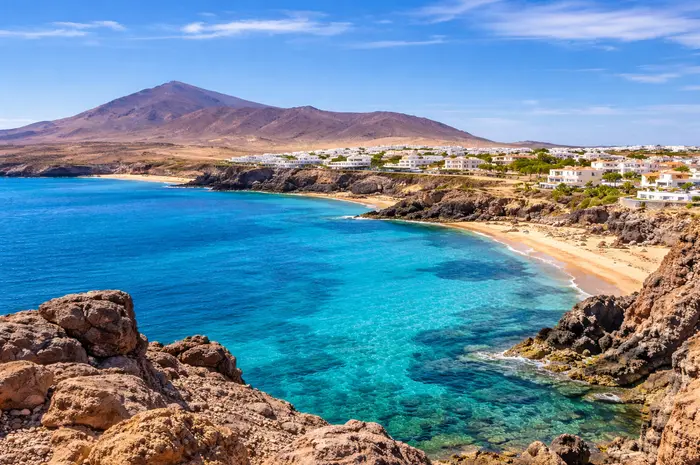
The Canary Islands sit in the Atlantic Ocean, off the northwest coast of Africa. Politically Spanish. Culturally unique. Climatically blessed.
From east to west, the main islands stack like this:
- Lanzarote
- Fuerteventura
- Gran Canaria
- Tenerife
- La Gomera
- La Palma
- El Hierro
That eastern position is exactly why Lanzarote keeps coming out on top.
It’s simply the first island you reach when flying southwest from the UK.
Distance vs reality: Why Lanzarote usually wins
On paper, the distance difference between Lanzarote and Fuerteventura isn’t dramatic. We’re talking tens of miles, not hundreds.
But air travel isn’t about paper. It’s about patterns.
Flight routing and scheduling
UK airlines have been flying to Lanzarote in high volume for decades. That means:
- More direct routes
- More flight frequency
- Less padding built into schedules
As a result, London to Lanzarote regularly clocks in around 4 hours to 4 hours 15 minutes, depending on winds and departure airport.
Fuerteventura often comes in slightly longer. Tenerife and Gran Canaria longer still.
Not by much. But enough to notice when you’re travelling with kids, or flying at the crack of dawn.
A practical comparison: The main contenders
| Island | Typical direct flight time from London | Best known for | Transfer ease |
| Lanzarote | ~4h–4h15 | Simplicity, scenery, relaxed resorts | Very easy |
| Fuerteventura | ~4h15–4h30 | Beaches, space, wind sports | Easy |
| Tenerife | ~4h30–4h45 | Variety, nightlife, families | Varies |
| Gran Canaria | ~4h30–4h45 | Year-round balance | Varies |
Those extra 15 to 30 minutes don’t sound like much. But they often come with longer taxi times, busier airports, and lengthier hotel transfers.
This is where Lanzarote quietly pulls ahead.
Why Lanzarote feels easier than other Canary Islands
Closeness isn’t just about flight time. It’s about how quickly your holiday starts.
One main airport, well placed
Lanzarote has a single, efficient airport. It sits right by the island’s main resort strip.
That means:
- Puerto del Carmen: around 10–15 minutes
- Costa Teguise: around 20 minutes
- Playa Blanca: roughly 35–40 minutes
Compare that with Tenerife, where you might land at the south airport but stay an hour away in the north, or Gran Canaria where resort transfers can stretch past an hour.
Lanzarote wastes very little of your time.
The island itself: Why people keep coming back
Here’s where storytelling matters. Because people don’t just return to Lanzarote because it’s close. They return because it feels different.
The landscape is volcanic and dramatic. Black earth. Rust-red mountains. White villages built low and clean against the land.
That aesthetic comes from strict planning laws inspired by local artist César Manrique. No high-rise chaos. No neon skyline.
Just space, light, and calm.
For UK travellers, especially those escaping winter, that contrast is powerful.
When another island might actually suit you better
This is where most ranking pages fall down. They declare a winner and stop thinking.
You shouldn’t.
Choose Fuerteventura if beaches matter more than flight time
Fuerteventura is only slightly further west, but it feels very different.
Longer beaches. Fewer crowds. More wind. More space.
If your dream holiday is walking for miles along pale sand with nothing but ocean noise, the extra minutes in the air are worth it.
Choose Tenerife if variety is your priority
Tenerife is bigger, busier, and more complex.
It offers:
- Family mega-resorts
- Lively nightlife
- Quiet northern villages
- Mount Teide’s dramatic landscapes
You trade closeness for choice.
Choose Gran Canaria if you want balance
Gran Canaria sits somewhere in the middle. A bit of everything. Beaches, cities, mountains.
It’s not the closest. But for some travellers, it’s the most versatile.
What about flying from outside London?
This matters more than people think.
From Manchester, Glasgow, Edinburgh, Birmingham, Bristol, and Newcastle, direct flights to Lanzarote remain among the most frequent in the Canaries.
That consistency keeps flight times competitive and pricing sensible.
In contrast, some western islands rely more heavily on seasonal routes or connections via Tenerife.
If you value simplicity, Lanzarote still tends to win.
The seasonal angle: When closeness really matters
Winter travel
From November to March, UK travellers flock south chasing light and warmth.
In winter, shorter flight times feel longer. Dark mornings. Tired children. Delayed departures.
That’s when Lanzarote’s efficiency really shows its value.
Summer travel
In summer, the difference matters less. Flights feel easier. Energy is higher.
At that point, destination personality may outweigh pure closeness.
A short, honest weather note
All Canary Islands enjoy mild winters and warm summers. But there are differences.
- Lanzarote and Fuerteventura are sunnier and drier
- Tenerife and Gran Canaria have more microclimates
- Wind is more noticeable on the eastern islands
None of this should put you off. But it should shape expectations.
Sample short-break itineraries (because closeness suits shorter stays)
3 days in Lanzarote
- Day 1: Arrival, beach, sunset dinner
- Day 2: Timanfaya National Park and volcanic coast
- Day 3: Local markets, seaside walk, fly home
Minimal travel. Maximum impact.
4 days in Fuerteventura
- Day 1: Arrival and beach reset
- Day 2: Corralejo dunes
- Day 3: Coastal drive or boat trip
- Day 4: Relax and depart
Island hopping: Yes, it’s possible
If you like the idea of seeing more than one island, Lanzarote gives you options.
A short ferry connects Lanzarote and Fuerteventura, making a two-island holiday realistic without exhausting travel days.
This is another quiet advantage of starting on the eastern edge.
Final Words
If your goal is simple, stress-free travel from the UK with minimal wasted time, Lanzarote is usually the smartest choice.
It’s close. It’s efficient and easy to love.
But the Canary Islands aren’t a one-size-fits-all destination. The right island depends on what you want to feel when you arrive.
Closeness gets you there faster.
The right choice makes you want to stay.
And that’s what good travel decisions are really about.
Want more smart, no-fluff travel insights? Explore more guides from Caledonian Travel.
Frequently asked questions
Lanzarote is generally considered the closest, both geographically and in terms of typical flight time.
Most often, Lanzarote. Though winds and routing can occasionally blur the margins.
No. Fuerteventura sits just west of Lanzarote, making it slightly further from the UK.
Roughly 4 to 4 hours 45 minutes, depending on island and departure airport.
Not always. Prices depend on demand, season, and airline competition. But Lanzarote often offers strong value due to volume.